
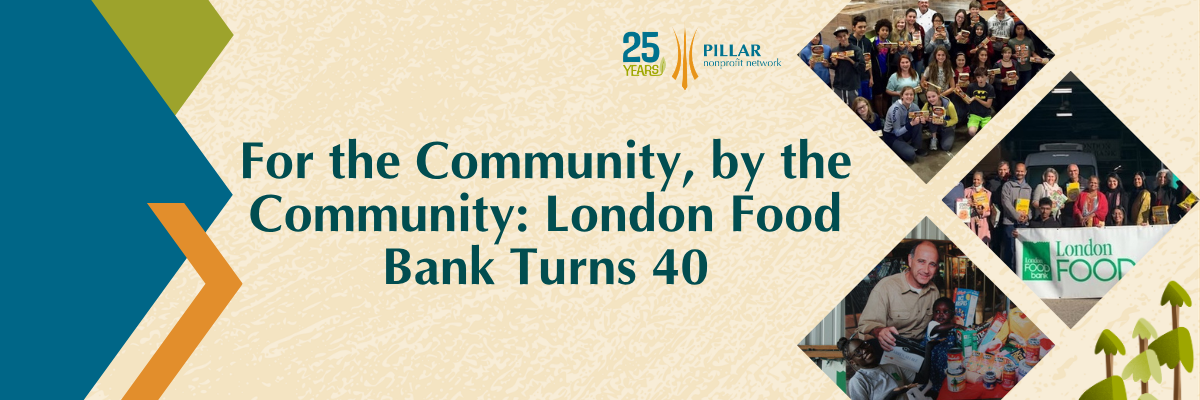
"The celebration is not for the food bank; it's for the community." - Glen Pearson, Co-Executive Director, London Food Bank
In 1986, hunger in London was a quiet secret.
"Back then, hunger didn't seem like such a big issue. London didn't know about it," says Glen Pearson, co-executive director of London Food Bank. "But it turned out there was actually a fair bit, and the agencies knew those stories, but the public didn't."
Glen was a firefighter then. A recession was hitting families hard, and the mayor had just returned from a visit to Canada's first food bank in Edmonton. He asked Glen whether he would help start one in London.
Glen agreed, but first he listened. He visited 17 agencies that were already feeding people and told them plainly: "We won't start a food bank if you don't think we need one." All but one said they needed help.
So London Food Bank was born, on Dundas Street, helping about 360 people a month. From the very beginning, it kept only half of what was donated and shared the rest with other agencies. "Not so much because we were generous," Glen says, "but we thought we wanted to support the groups that were doing the work."
Forty Years Later
“Today, the food bank helps about 17,000 people every month, roughly 10% of London, including all the programs it assists,”Glen says. It supports 40 other agencies and 90 feeding programs.
For Glen and his wife, Jane Roy, who leads the food bank alongside him as co-executive director, that growth is not a victory. "What's sad about it, though, and where I don't necessarily feel a lot of success, is that it has grown every year," he says. London should never have needed a food bank at all, "and we say that every year."
So when the media wanted to celebrate the couple for 40 years of service, they said it was the wrong emphasis. The food bank has never taken government money, applied for grants, or run fundraising campaigns. Glen didn't take a wage from it for 30 years, even while he served as a member of Parliament. Everything has come from Londoners.
That, Glen says, "says a lot more about the community than it does about the food bank." So the anniversary became a public event with the whole city invited.
A City That Shows Up
The proof is everywhere. More than 1,000 businesses support the food bank through Business Cares, an idea Glen shared with his friend Ed Holder about 25 years ago. Today, in just three weeks each holiday season, it gathers over a million dollars' worth of food.
Then there are the volunteers, all 4,200 of them, so many that the building can barely hold them. Some volunteer work takes real skill. But some of it doesn't, which is the beauty of it. "A five year old can come down to the food bank and tell the difference between a box of Kraft Dinner and a turnip," Glen says. Children help pack hampers. People of every ability pitch in.
When Nobody Knew What to Do
In March 2020, Glen came home from South Sudan, where he and Jane have run an NGO for the past 27 years. The next day, the pandemic was declared.
Agencies were closing. Staff were being let go. The city asked the food bank to stay open. "Everybody was confused," Glen remembers. "We were confused down at the food bank about COVID."
Then, on a Saturday morning in those first weeks, the phone rang. It was a call from Pillar. People were hungry, but there weren't enough places to prepare meals for them. Meanwhile, RBC Place had shut its doors, and its director wished there was a way to use its industrial kitchens.
Two days later, Glen met with Pillar, then sat down with homelessness agencies.Within a week, meals were being made and delivered, and the food bank spent almost $2 million on the effort in that first year. At a time when the media "was looking for any kind of hope," this became one of the stories they told.
"None of that would have happened without Pillar," Glen says.
Taking the Blinders Off
Walking into Pillar isn't always easy for Glen. "I can hardly ever come here without an agency wanting to talk and wonder if they can get some funding or getting some food," he says. "It's sometimes hard to come into Pillar because that is what happens."
But those conversations showed him how hard things had become, not just for the people who are hungry, but for the agencies trying to help them. He took what he learned to his board, and the food bank expanded the number of groups it supports.
"Because we only do food, there could be a chance in which we put blinders on," he says. "Pillar has taken those blinders off."
A Challenge for the Sector
Today, one in three children in London is food insecure, according to the health unit, double the rate in 2023. Glen believes lasting solutions lie with the province and with governments living up to their responsibilities. But he worries that too many organizations stay quiet, with "a hesitancy to speak up in case they lose funding."
He sees Pillar as the natural place to bring civil society together. "Pillar is the best choice," he says. He's candid that no one has found the formula yet: not Pillar, not business, not politics, and not the food bank. He dreams of the day "three busloads" of Londoners from civil society arrive together to ask governments to show up.
He'd also like to see Pillar take on food security more directly, and to build a closer relationship with the public. When core funding and grants dry up, he says, "all that's left for you is the public."
They Know How to Care
After 40 years, Glen has learned to trust that public completely.
"People don't know how to organize in the city," he says, "but they know how to care, and they know how to donate, and they know how to be there when people are in need."
"This public really does care."
That's why, at 40, the celebration was never about the food bank. It was for them, the community that has shown up for the last 40 years.
Learn more, donate, or volunteer: http://www.londonfoodbank.ca/