"People know our events, but they don't know the faces behind the events." - Dhira Ghosh, Director of Operations, London Heritage Council
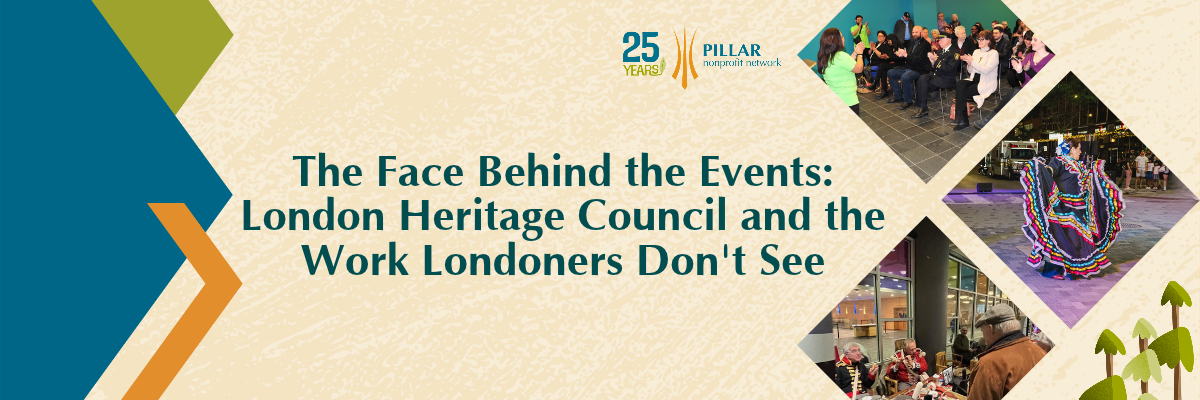
If you've wandered through a building during Doors Open London, visited the Heritage Fair, or celebrated Canada Day at the downtown night market, you've experienced the work of the London Heritage Council. You just might not have known it.
"People think it's the city," says Dhira Ghosh, the Council's director of operations, who has been with the organization the longest. The Heritage Council was originally created by the City of London, but it is an independent, community-based not-for-profit, without access to the city's resources. "But we still do that kind of big events, widespread events," Dhira says. In a way, the confusion is a compliment: the events run so smoothly that people assume a much bigger organization is behind them.
A Year Full of History
The Council's calendar is packed. It begins in February with the Heritage Fair, a week-long celebration of all things heritage, hosted in partnership with the London Public Library at its Central branch. Summer brings the Canada Day night market. This year's Doors Open London opened 40 sites across the city, giving people a rare look inside places they normally can't visit.
For London's bicentennial, the Council is hosting the London Bicentennial History Symposium. It brings together speakers on the city's history, museum partners for a mini heritage fair, and a poster session by students in Western's Public History program.
The Council's work also runs year-round. Through Museum School London, students from kindergarten to Grade 8 spend an entire week at a local museum, learning history through hands-on, curriculum-based programs. The Council offers historical tours at Labatt Park and runs a seasonal collection in its Roy McKay Clubhouse during baseball season.
It also brings together the city's 15 museums through a regular network meeting. On behalf of the city, it runs the Community Heritage Investment Program, which funds heritage and advocacy groups and museums. And with settlement agencies, it delivers Experience London, which gives newcomer families a one-year pass to visit participating institutions.
What Heritage Really Means
Many people hear "heritage" and think only of old buildings. The Council regularly gets calls like, "I have an 1825 house and the porch needs to be fixed." "That's not who we are," says Terri Smale, the Council's executive director. "There's a misconception about what heritage represents."
Heritage also often gets lost in wider conversations about culture. London is now a UNESCO City of Music, and the arts have a strong, vocal community. "Heritage by nature tends to be a little more shy about using the loudspeaker," Dhira says.
Terri sees room for the whole sector to do better at profiling heritage, and to make sure it has a seat at the table when decisions are made. That matters because heritage councils are rare in Canada. "The fact that London has a heritage council is something that's very commendable," Dhira says. "It's just that London needs to bring attention to that."
Community Connectors
Every Heritage Council program is a partnership. It works with Fanshawe, Western, police services, the arts community, museums, advocacy groups, and settlement agencies. When a museum or settlement agency needs a connection, they call the Council.
"I don't think we've ever said no to any organization that has wanted to work with us," Dhira says.
That spirit goes back to Pillar Nonprofit Network’s (Pillar) early days. The Heritage Council, then joined with the Arts Council, was a founding partner of Innovation Works. Dhira was on the subcommittee that cold-called organizations to fill the building, and the Council helped put together its opening event.
Over the years, the Council worked most closely with Dharshi Lacey at Pillar, who supported its board governance, led diversity, equity, and inclusion training for its staff, board, and museum partners, and invited the Council onto a diversity committee. "The kind of initiative she did, it really resonated with us," Dhira says. Terri describes Dharshi as "a strong advocate" with "a really well-respected program." With so many connections across sectors, Dharshi was someone Dhira could simply walk over to with a question.
Dharshi was a true community champion, and her impact didn't end when she left Pillar to be closer to her family. Her legacy inspired the Dharshi Lacey Catalyst Fund, which now supports Pillar's Inclusive Community Events Program, helping grassroots groups create welcoming, inclusive spaces for their communities.
"Shared is always better, and working together is always better," Terri says. "You have a stronger voice and you have a stronger position when you work together."
An Open Chapter
The Council's next chapter is uncertain, and its leaders are candid about it. Funding and the city's direction on culture remain open questions. "To be determined," Terri says.
What is certain is the impact. The next time you step through a door that's usually closed, you'll know who opened it.
Learn more about London Heritage Council: https://www.londonheritage.ca/