
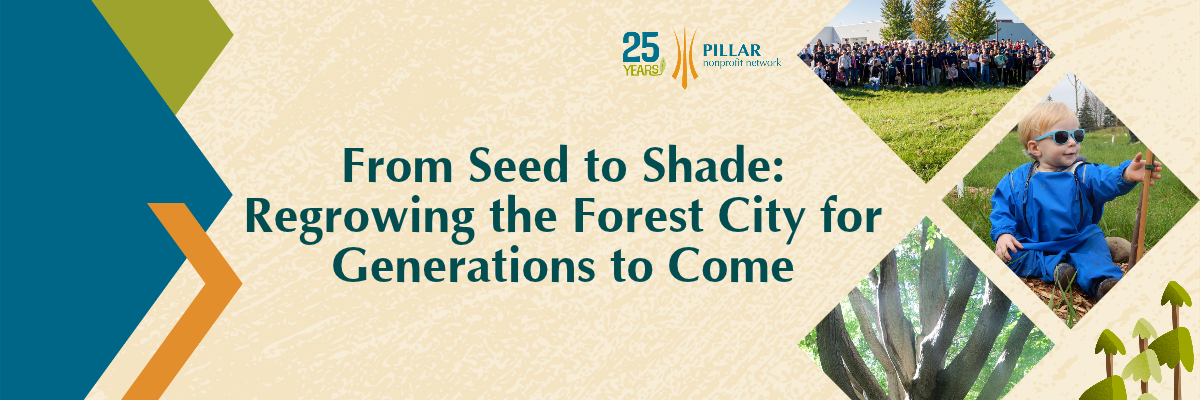
"Hopefully my kids and my grandkids get to live in the shade that we decided to plant here." - Shaquille Sealy, Executive Director, Reforest London
A redbud seed is tiny, "essentially the size of fish food," says Shaquille Sealy, Executive Director of Reforest London. You plant it, water it, and weed it. "You're insisting on this thing having a chance at life and growing."
After a year, the seedling stands about a foot tall. Then it goes into the ground, where it can take seven to 10 years to reach its full height and spread.
Shaquille thinks about the Meeting Tree in the Westminster Ponds Environmentally Significant Area. It began as a little acorn, and generations upon generations cared for the land around it so it could grow. Now he can sit under its shade. "That's the impact that we're having," he says.
The work, he says, "keeps me humble."
Grow, Plant, Care, Together
Reforest London is committed to environmental stewardship and to sustaining and enhancing the urban forest in London and the surrounding region. Reforest London is committed to environmental stewardship and to sustaining and enhancing the urban forest in London and the surrounding region. Its work is guided by four pillars: Grow, Plant, Care, and Together. Through Together, the organization brings the community into its work, including by educating the public on how to be better environmental stewards.
It all began with a small group of concerned citizens who watched a tree come down on Emery Street and decided the city needed to do a better job of caring for its urban forest. Their idea grew over two years. Reforest London was incubated in 2005, with the Urban League helping to facilitate early conversations, and became a registered charity in 2007. Last year, it celebrated its 20th anniversary.
Some of its earliest plantings are now growing into beautiful naturalized areas. "It's really awe-inspiring to be at this juncture," Shaquille says.
A Nursery That Flipped the Numbers
The newest piece, growing, arrived last year with the launch of Reforest London's Community Tree Nursery. It was made possible by partners including the Government of Canada (2BT program), City of London, TD, Canada Life, and DeCloet Greenhouse Mfg. Ltd., which donated a portion of the greenhouse.
The vision was never simply a business, but "a community tree nursery, really run and operated by the community." The team hoped the nursery would supply about 30% of its trees in the first year. Instead, about 80% of the trees in its planting projects now come from the nursery. An Ontario Trillium Foundation Seed grant for SPROUT (Sowing Potential, Resilience, Opportunity, Understanding, and Trees) is also bringing youth workshops to the nursery, and the team is already ahead of schedule.
The nursery completes a cycle: seed to seedling, seedling to planted tree, and care for that tree's whole life. Along the way, Shaquille hopes communities grow closer and healthier, and that London truly lives up to its name as the Forest City..
Trees for Tots
In his first year, Shaquille met staff from Childreach at a Pillar Nonprofit Network (Pillar) event. Soon after, he reached out with a pitch. "I have a crazy idea. We are going to have your infant play group plant trees," he recalls. The name came first: "It's called Trees for Tots."
Childreach said yes. Toddlers and their parents planted small plugs together, and a photo from the event made the cover of that year's annual report. As a new employee, having direct access to another organization's leaders gave Shaquille confidence. "That probably wouldn't have happened had we not gotten introduced at a Pillar event."
Growing Together
Reforest London joined Pillar around 2010, as it prepared to launch the Million Tree Challenge with the City. The London Environmental Network, which Reforest London helped incubate, was just getting started, so the small team turned to Pillar for advice and resources. Since then, Pillar's public policies and bylaws helped it through its ONCA transition, a Pillar SDG cohort helped it plan for sustainability beyond trees, and its staff and board continue to use Pillar's learning programs.
Pillar also does work small organizations can't. Shaquille points to its advocacy at the municipal, provincial, and federal levels, including on community grants. Nonprofits like his "don't have the staffing or time really to step up into those arenas as much as we wish we could," he says, "and Pillar does that for us."
And it brings unlikely partners together. At a Pillar Impact Chat on the environment, Shaquille heard Type Diabeat-it, which uses gardening and food preparation to support people living with diabetes, share the stage with a private company and London Hydro, each describing their environmental work from a completely different angle. "That couldn't have happened without Pillar having the foresight to say, 'This is an important conversation to have.'"
Shaquille tells every new staff member that "the first thing you need to do is introduce yourself to Pillar staff." He also credits Pillar's people for modelling the values other organizations hope to emulate. "You challenge us to start asking those challenging questions and improve our organizations from the inside out."
His message for Pillar's 25th is gratitude: "Keep being yourselves, keep doing what you're doing."
Like a redbud in its first year, the work is still young. But Reforest London is planting for the long run.
Learn more about Reforest London: https://www.reforestlondon.ca/