
"The history didn't start 400 years ago with slavery. It started millennia ago." — Carl Cadogan, Chair, London Black Heritage Council
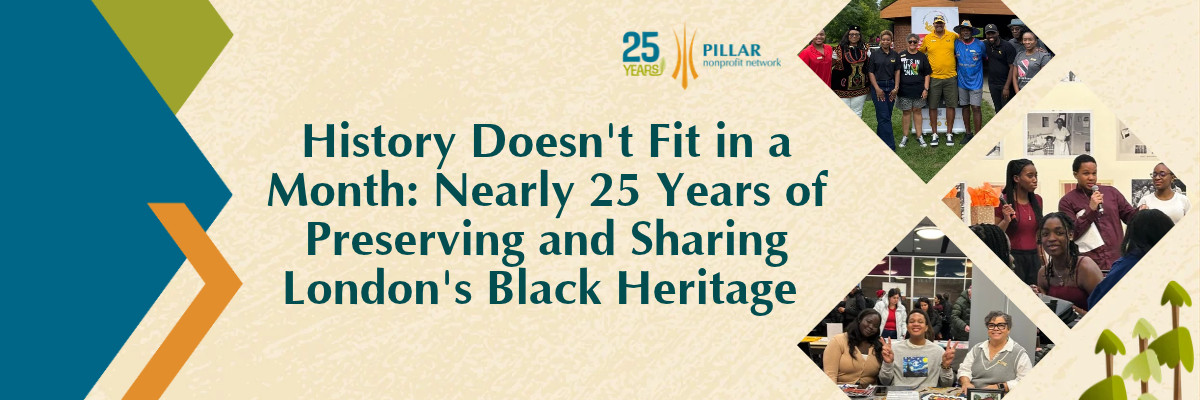
When Carl Cadogan arrived in London in 2001, one of the first events he attended was a Black History gathering at Museum London. Twenty-five years later, he chairs the organization that grew out of that early work: the London Black Heritage Council (LBHC).
The Council began almost 25 years ago as a small volunteer committee organizing Black History Month events each February in 2002. It grew out of Building Community Leadership Capacity (BCLC), a national initiative that helped Black communities across Canada build skills in community development and leadership. At a BCLC forum, members discussed what they should focus on. History, and educating the broader public about it, rose to the top. For Carl, that history is far longer than many people realize. "It didn't start 400 years ago with slavery," he says. "It started millennia ago."
The group began as the Black History Month Committee in and later became the Black History Coordinating Committee (which became the London Black History Coordinating Committee in 2010), sharing information about Black history events across London and southwestern Ontario. For most of its life, it stayed deliberately low-key: a chair, a few committee leads, and a lot of volunteers. The London Cross Cultural Learner Centre provided administrative support throughout, managing funds and allowing the committee to operate under its charitable status. Carl describes it as "a very symbiotic and strong relationship."
As the pandemic was winding down, the group began asking how it could do more. With strategic planning support from Pillar Nonprofit Network and a one-year staff position funded by the London Community Foundation, it became a provincially incorporated not-for-profit. It took the legal name
London Black Heritage Council, adopted bylaws based partly on Pillar templates, and formed a nine-person board. The Council is now applying for charitable status of its own. The original coordinating committee continues to lead Black History Month programming. The Council has also gifted more than two decades of documents and materials to Western University. "We wanted to ensure that not only the history, but documents and materials… didn't just sit in someone's basement or garage," Carl says.
Saving a Chapel, Fifteen Years in the Making
Asked about his proudest moment, Carl points to the Fugitive Slave Chapel. Built in 1849 by the African Methodist Episcopal Church, it served its congregation until about 1969 and later became a family home.
In 2013, when a developer planned to demolish it, the community rallied. The building was saved and moved beside Beth Emanuel Church, with hopes of turning it into a Black history museum. The money raised was never quite enough. Over the years the building suffered weather damage and break-ins.
The Trustees of the British Method Episcopal Church (Toronto) approached Fanshawe Pioneer Village to accept the AME Church. They agreed to accept this on two conditions : the Black community had to be consulted, and enough money had to be raised to restore it.
A broad coalition came together to meet those conditions. LBHC, working with Fanshawe Pioneer Village, the London Heritage Council, the Congress of Black Women, The City of London, historians from Western University, and many others. Donations ranged from $50,000 from a local developer and $5,000 from the Catholic diocese to $10 gifts from individuals."We had commitment and response from the whole community," Carl says.
Filmmaker Anthony Sherwood was so moved by the effort that he offered to document it at his own expense. His film,The London Chapel Project, just under an hour long, follows the chapel's journey to Fanshawe Pioneer Village. It premiered during Black History Month 2023 and is now held by Fanshawe Pioneer Village, LBHC, and Western University.
Today, the restored chapel is a working space for learning. The Council co-hosted Emancipation Day activities at the site in 2022, before the chapel's arrival, and in each following year from 2023 to 2026, and is developing educational materials so visitors can understand its history. "It's not just a restored building," Carl says, "but history that continues to really work to highlight the contributions of the Black community."
Growing Together with Pillar
Carl's connection to Pillar goes back to the very beginning: he was one of its founding board members. The founders wanted to create something like a Chamber of Commerce for charities and originally planned to call it the "Chamber of Charities." The name was dropped after the local Chamber objected. The replacement, Pillar, reflected the three sectors it would bring together: charitable, business, and community.
For a volunteer group whose largest budget was once three or four thousand dollars, Pillar offered learning opportunities, a place to post volunteer roles, and connections across the sector. Through Pillar, Carl also became involved with the Ontario Nonprofit Network. LBHC and Pillar have co-hosted Black History Month events for five years, and is a tenant at Innovation Works, Pillar's shared workspace for social impact organizations in downtown London.
Carl sees the relationship as mutual. "It's not a one-way street," he says. "It's really a reciprocal community development, community capacity, community impact."
He is candid about why many small Black-led groups have hesitated to join networks like Pillar. "You sit beside an organization that has executive directors and staff and all this stuff. It's very intimidating." His message to them is simple: membership is free, and "it's not going to hurt you to become a member… You can learn."
Looking Ahead
Pillar marks its 25th anniversary in 2026, and the LBHC will reach its own in 2027. The two organizations are already planning a significant joint project for the Council's milestone. Carl's hope for Pillar's next 25 years is a bigger, more diverse network, including "not only organizations that are Black-led, but organizations that are led by other groups in the community."
LBHC is busy. Its board meeting this summer was scheduled for 35 minutes and ran well over. Carl's challenge now is balancing that energy against the risk of burning out volunteers, "but at the same time we're not missing out on doing things to have a greater impact on the Black community."
Get involved: To learn more about the London Black Heritage Council, volunteer, or attend upcoming Black History Month events, visit https://londonblackheritagecouncil.ca/